


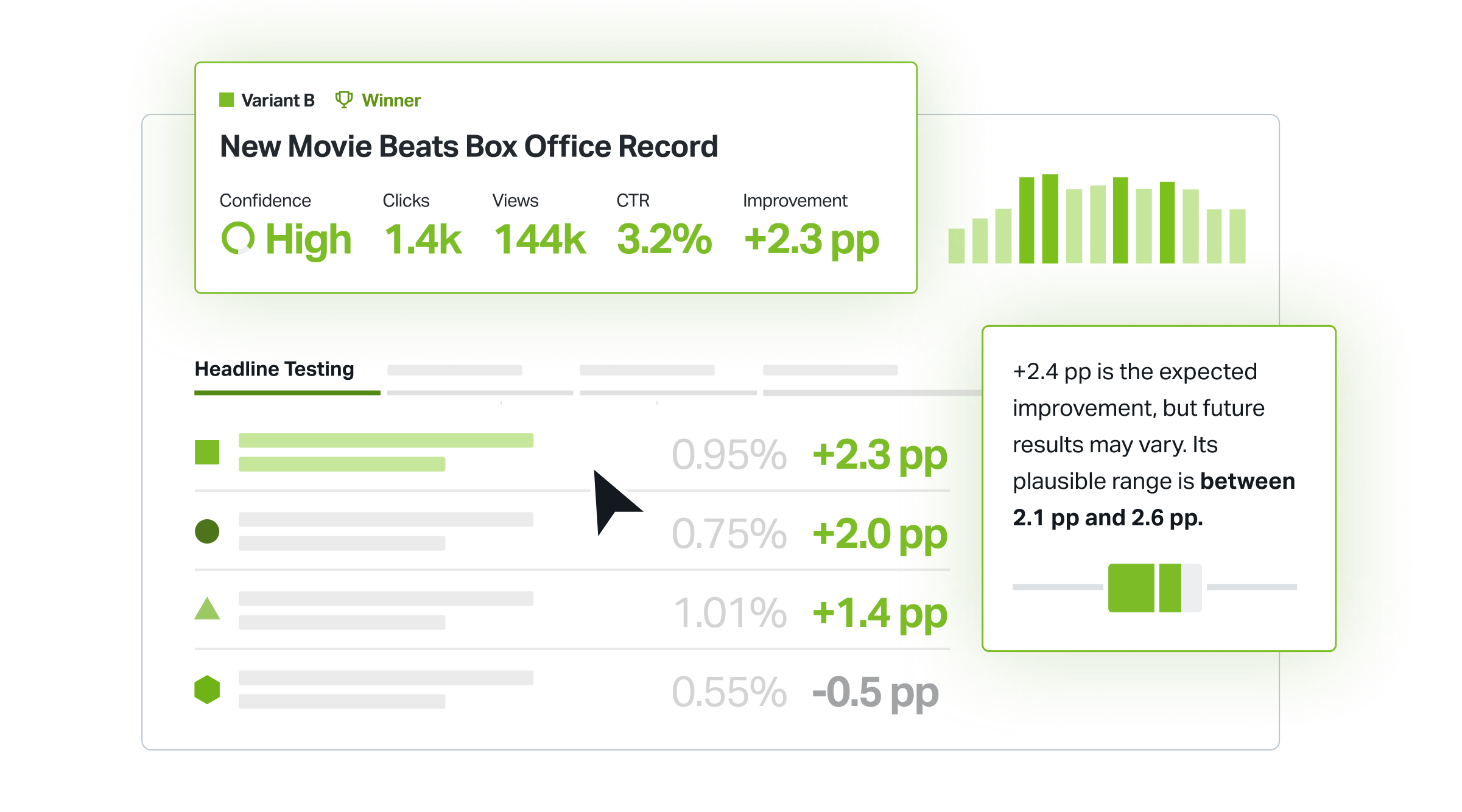
Earlier this year, we introduced headline testing in open beta—and many of you jumped in to experiment, optimize, and share feedback. Today, we’re excited to share that headline testing is now fully launched and available to all Parse.ly customers.
Thanks to your input, we’ve made headline testing more powerful and easier to use. From AI-generated variants and draft mode to improved reporting, alerts, and a streamlined interface, every update was shaped by real editorial workflows.
Here’s what’s new and why it matters:
Smarter Optimization with AI and Flexible Testing
You can now generate headline variants with AI, draft experiments, and adjust your control headline. This gives teams more creative options and full control over experiments.
Faster Insights and Real-Time Actions
Improved algorithms now identify winners more accurately and quickly. Combined with flexible headline swaps, even after content loads, and automatic alerts when tests conclude, teams can act on insights at the right moment.
Seamless Collaboration and Workflow Integration
Granular permissions, filters, and search options help teams find, manage, and run tests effortlessly, ensuring the right people have the right access without slowing down content production.
Deeper Reporting and Shareable Results
Exportable test performance data allows you to share results across teams or integrate insights into broader analytics and strategy discussions.
A Better Experience for Editorial Teams
The refreshed UI/UX is designed to simplify testing and make optimization part of your natural editorial flow.
All these enhancements have been rolled out directly to the Parse.ly Dashboard, based on user feedback and continuous data-driven improvements.
To start running tests, you’ll just need to add a one-line snippet to your site — it takes less than a minute.
Improved algorithms for winner determination
To recap, our headline testing engine relies on multi-armed bandit (MAB) algorithms and Bayesian statistics.
During the test, we use a multi-armed bandit to dynamically allocate the traffic to headlines. At the start, it makes no assumptions about their performance. As traffic starts coming, the likelihood of each headline being the best gets recalculated regularly. The system uses these calculations to update the traffic allocation, enabling the system to prioritize the winning headlines even before the test is over.
Once the test is over, we use Bayesian modelling to predict the future performance of each variant. These predictions take the form of probability distributions for the click-through rate for each headline. The improved algorithms that we’re introducing are focused on simplifying that information and making it actionable. Chiefly, all test results will now include a confidence grade based on the calculated probability that the given headline will have the best click-through rate in the future (aka win chance). It should be understood as the degree of certainty.

To communicate the win chance and other key information, we’ve refined our results dashboard with additional features focused on supporting decision-making. Find out more about how to read the headline testing results.
If you have questions or feedback about Headline Testing, please reach out to us. Your input helps us continue building features that make Parse.ly even more valuable for your team.